
What's It Take To Get You To Write? by Jude Hopkins, 3/14/26
Updated: Mar 16

I've had a bit of writer's block of late.
Many are the reasons, but my emphasis herein must be on the process of how writers overcome it or, at least, how they lure the muse to work her necessary magic.
I read that one of my favorite writers, John Updike, never had writer's block. His output of novels, poems, and essays serves as evidence.
I'm no Updike, but I have published a book, Babe in the Woods, as well as poems and essays. And the desire is always there to get back to writing. So, what would help me return to the scribbler's life?
In a wonderful essay for Lit Hub titled "Coffee, Booze, Undressing, Deprivation: How Writers Get in the Mood to Write," author Caitlin Shetterly recounts the ways some famous writers use (or used) to help them transfer the words swirling in their thoughts onto the page. She said Hemingway needed a drink to loosen him up (by the way, he was not the one who said "Write drunk; edit sober." That was another one of the writers I admire, Peter DeVries, in his book Reuben, Reuben). John Cheever had to don a three-piece suit before he wrote, only removing his jacket and tie when he had taken the elevator from his apartment to the basement. Shetterly quotes Barbara Kinsolver as saying, "The school bus was my muse."
In the insightful book The Creative Process edited by Brewster Ghiselen, a book introduced to me by my rhetoric teacher many years ago, I read about the various rituals certain writers performed that helped them get those black squiggling lines onto a piece of paper. One of those featured therein was the great German dramatist and poet Friedrich Schiller who had to have a smell of rotten apples hidden underneath his desk lid when he was composing poetry. Walter de la Mare, another poet, needed to smoke while he wrote, whereas the great W.H. Auden drank endless cups of tea.
Essentially, all rituals and rites and habits a writer goes through to begin writing is to help with one thing, poet Stephen Spender said: "The problem of creative writing is essentially one of concentration."

Whatever helps you to concentrate is worth exploring if it does the trick. However, as Charles Bukowski warns us in his poem "Air and Light and Space and Time," one can go too far, hoping that things are "just so" before even considering putting pen to paper or fingers to keyboard. Here's the last stanza of that insightful poem:

As I mentioned above with Updike, some writers don't need any impetus to write, just discipline. In her essay, Shetterly said she spoke to Ann Patchett who told her she makes a point of not doing anything special to prepare for writing. But most of us, I venture, do require some preparatory acts for what we hope to be a productive writing session.
If you're not into more creative approaches as those outlined above and are still having trouble getting into the groove, then I recommend the commonsensical methods suggested by author Amie McNee in her book We Need Your Art: Stop Messing Around and Make Something. She offers up a program—what she calls a two-week reset—that she promises will "support you whenever you feel like you've wandered off the creative path." Although she's tailoring her suggestions for procrastinators, the program would work for those unable to light enough candles, brew enough coffee, or find the right atmosphere to help them recharge.

In fact, McNee has this to say about one's writing environment: "It's important, but obsessing over it can also get in your way. I want you to give yourself five minutes maximum to make your environment as conducive to art as possible. Put a timer on. I recommend setting your phone to airplane mode, putting on some music, and decluttering. Have all your equipment ready, too. When that timer goes off, you start creating. No more fussing with your space."
As for me, I guess you can see that my writer's block broke up like an ice floe in spring. I haven't quite figured out what exact cause or causes were behind it. Nevertheless, I welcome the breakthrough. Perhaps it was a string of recent illnesses that made me value the time I'm not sick. I still have a lot to say. Or it might be a case of bad news everywhere. The world can be too much with us.
So I put on my background music (has to be instrumental like Pat Metheny or light classical), got comfortable (but not too comfortable), let some outside light in, and began typing. The most important thing to remember if you're creatively stuck is finding a way to get back to your work. Keep talking to yourself about what you still want to accomplish.
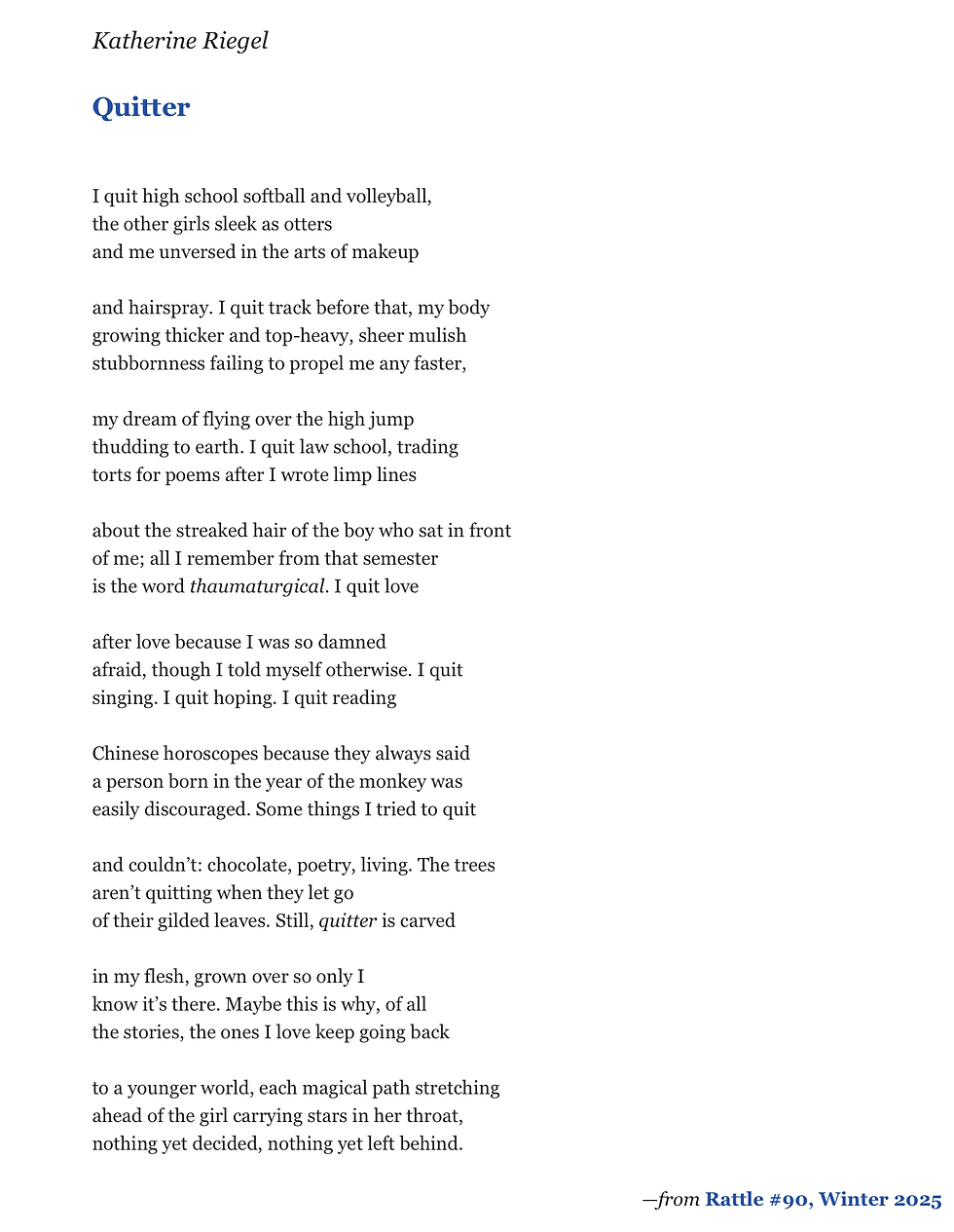
The worst thing would be to quit entirely. I saw the following poem. "Quitter," by Katherine Riegel in Rattle recently (Winter Issue 2025). Read it. Then tell yourself you are still "the girl carrying stars in her throat ... nothing yet left behind."
And write like you mean it.


Comments